Key Points
- How much does a nurse make? RNs earn a median of $97,550 a year, or $46.90 an hour (BLS, May 2025).
- The lowest-paid 10% earn less than $68,940, and the highest-paid 10% earn more than $137,470.
- California pays RNs the most ($140,270), and 13 states plus DC have medians of $100,000 or more.
- RNs in government jobs earn a median of $110,780, the highest of the main work settings.
- BLS reports one wage for all RNs, whether they hold an ADN or a BSN.

Average RN Salary and Pay Range
The nurse salary figure most people quote comes from the BLS Occupational Employment and Wage Statistics survey for May 2025, which covers 3,379,720 RN jobs. It puts the median registered nurse salary at $97,550 a year and the median hourly rate at $46.90, and O*NET's copy of the same BLS data lists the full percentile spread. RN salary by percentile, May 2025:
The average nurse salary, meaning the mean, is $101,420, higher than the median because a smaller group of top earners pulls the average up, so the median is the better guide to what a typical RN earns. Demand supports the number. BLS projects RN employment to grow 6% from 2025 to 2035, faster than the average for all occupations, with about 180,800 openings a year, many of them from replacing nurses who retire or change occupations.
How Much Do Nurses Make an Hour, a Week, and a Month?
RNs earn a median of $46.90 an hour, and that registered nurse hourly wage is the number to compare across job offers, since employers quote hourly rates and annual pay depends on the hours behind them. The weekly and monthly rows are the annual median divided by 52 and by 12.
A second BLS source gives a lower weekly figure. Full-time RNs reported median usual weekly earnings of $1,563 in 2025 in the Current Population Survey, a household survey that runs lower than the employer survey behind the $97,550 figure, so you may see both numbers quoted.
The 2,080-hour assumption matters too. Many hospital RNs work three 12-hour shifts, and 36 hours at $46.90 comes to about $87,800 a year before overtime, differentials, or a fourth shift. That math is why two nurses at the same hourly rate can report very different annual pay.
Registered Nurse Salary by State
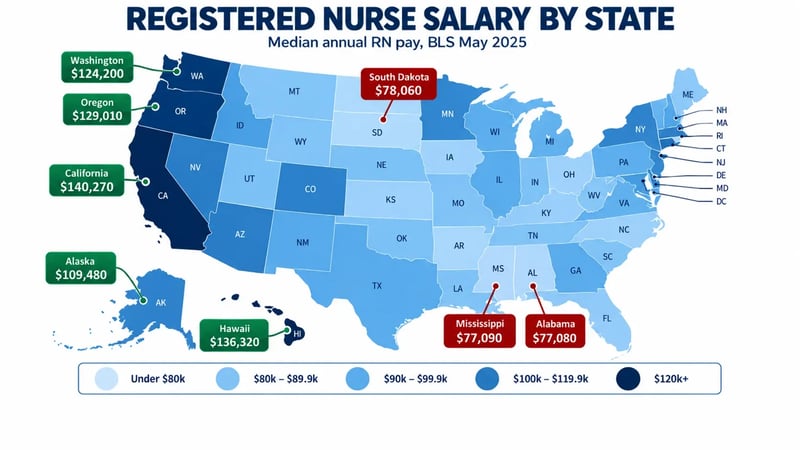
Where do nurses make the most money? California pays RNs the most, with a median of $140,270, followed by Hawaii ($136,320), Oregon ($129,010), Washington ($124,200), and Alaska ($109,480). Thirteen states plus the District of Columbia have medians of $100,000 or more, and the lowest medians are in Alabama ($77,080), Mississippi ($77,090), and South Dakota ($78,060). California is also the largest RN employer by far, with 338,940 jobs, ahead of Texas (271,380), Florida (229,940), and New York (205,810).
The table shows nurse salary by state for May 2025, from the BLS state wage estimates, sorted by median. The last column, the figure the lowest-paid 10% earn less than, is the closest public reference for starting nursing salary by state.
The high-paying states also come with higher living costs and, in most cases, state income tax, so compare two offers with rent and taxes in mind rather than on the gross figure alone.
Where RNs Earn the Most: Settings, Industries, and Metro Areas
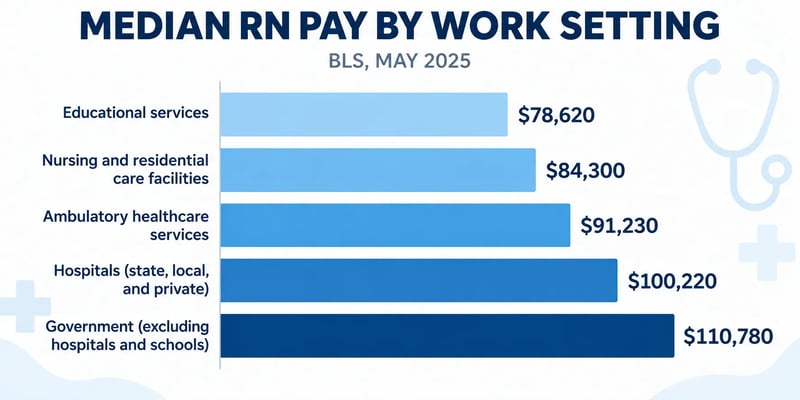
Work setting is the first lever, and the BLS handbook reports these May 2025 medians for the main RN employers:
- Government (excluding hospitals and schools): $110,780
- Hospitals (state, local, and private): $100,220
- Ambulatory healthcare services: $91,230
- Nursing and residential care facilities: $84,300
- Educational services: $78,620
The detailed industry data in the BLS OEWS profile sharpens the picture. The Federal Executive Branch pays the highest RN median, and these four large employers also pay above the national median:
- Federal Executive Branch: $121,260
- Specialty hospitals: $102,840
- Colleges and universities: $102,580
- General medical and surgical hospitals: $100,210
- Outpatient care centers: $99,350
Location is the bigger lever. The BLS metropolitan area estimates put the top seven RN medians in California, with Kahului-Wailuku, Hawaii ($144,350) the highest outside it:
- San Jose-Sunnyvale-Santa Clara: $216,740
- Vallejo: $203,290
- San Francisco-Oakland-Fremont: $186,610
- Santa Rosa-Petaluma: $174,550
- Sacramento-Roseville-Folsom: $171,460
The largest job markets sit closer to the national median, with New York at $119,720, Los Angeles $135,560, Boston $106,180, Dallas-Fort Worth $101,420, Chicago $100,490, Houston $99,830, and Miami $91,380. In all, 81 of the 380 metro and nonmetro areas BLS measures post RN medians of $100,000 or more.
Schedule adds a layer that BLS does not measure. Indeed's national RN page, built from 244,900 reported salaries as of July 2026, lists about $12,000 a year in overtime on top of base pay. In one widely shared r/Salary post, a San Francisco Bay Area operating room nurse with five years of experience described a $96 base rate, $10 an hour more for nights, and $5 more for weekends. Call paid $48 an hour at home and $144 when called in, and $30,000 to $40,000 of a $228,000 year came from call alone.
Starting RN Salary: What New Grad Nurses Earn
No government source publishes pay for new graduate nurses, so the BLS percentiles are the best public reference for entry level nurse salary. The lowest-paid 10% of RNs earn less than $68,940 a year ($33.14 an hour), and the 25th percentile is $80,330, which is where many new grads start. The 10th percentile also moves with the state, from $54,040 in South Dakota to $101,260 in California, so the state table above doubles as a starting-pay reference.
The higher percentiles, the settings, and the metro figures above show where pay can go from there, and a useful marker comes from the nurses themselves. In the National Council of State Boards of Nursing's 2024 workforce survey, RNs at every experience level reported median pretax earnings of $88,000, up from $80,000 in 2022. Self-reported pay runs below the employer-reported BLS median, but the marker still holds: a new grad should expect to start under that figure and pass it within a few years as differentials, certifications, and unit changes add up.
Does a BSN Pay More Than an ADN?
The BSN nursing salary question has a plain answer: BLS counts every RN in one occupation with one wage, $97,550, whether the nurse holds an associate degree, a bachelor's degree, or a diploma. There is no official BSN pay premium to quote, BSN nurses are RNs, and a two-year RN with an ADN holds the same license as a BSN nurse.
The part that matters for pay is indirect. BLS notes that licensed graduates of all three paths generally qualify for entry-level staff nurse jobs, but employers, particularly hospitals, may require a bachelor's degree. Hospital RNs earn a higher median ($100,220) than RNs in nursing and residential care facilities ($84,300). A BSN is also the usual path into graduate programs for the highest-paying nursing roles, and in the NCSBN survey 46% of RNs now start with a BSN, up from 39% in 2015.
If you are choosing between associate degree in nursing programs and BSN programs near you, compare total time and cost against the hospitals you want to work in. RN-to-BSN programs, many of them delivered as online registered nursing classes, let working nurses close the gap later, and the guide to registered nursing classes near you lists schools by state and city.
RN Salary Compared With Other Nursing Roles
Registered nurses sit in the middle of the nursing pay ladder, well above the assisting roles and well below advanced practice. Nursing pay by role, BLS May 2025:
The figures come from the BLS handbook pages for nursing assistants and orderlies, licensed practical and vocational nurses, and nurse practitioners and other APRNs, and each rung changes the scope of practice as much as the pay. The CNA vs. RN comparison covers the first step up, and the LVN vs. RN guide covers the second. The full nursing career ladder guide shows how each credential leads to the next.
Frequently Asked Questions