How to Become a Registered Nurse: Step-by-Step RN Guide
See if you qualify for Registered Nurse programs
Answer a few questions in 2 minutes. Free, no commitment.
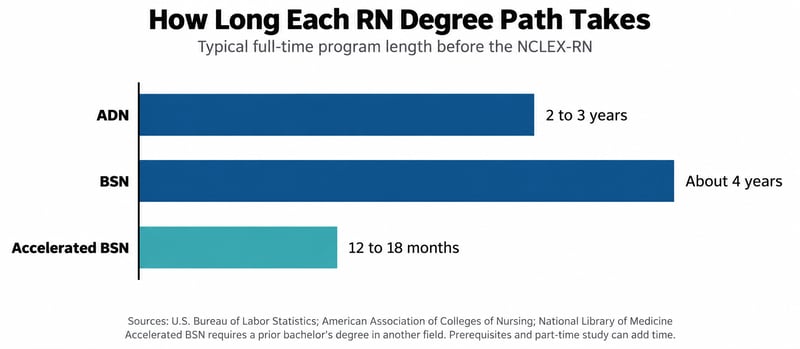
To become a registered nurse (RN), you graduate from a state-approved nursing program, pass the NCLEX-RN, and get licensed by the board of nursing in the state where you plan to work. The biggest decision is your degree. An Associate Degree in Nursing (ADN) is the fastest, lowest-cost route, while a Bachelor of Science in Nursing (BSN) takes longer and is the degree some employers, particularly hospitals, require. Both lead to the same exam and the same license. If you already hold a bachelor's degree in another field, an accelerated BSN takes 12 to 18 months. Registered nurses earned a median of $97,550 in May 2025, and the Bureau of Labor Statistics projects about 180,800 openings a year through 2035. Each state board issues its own license, so where you plan to work shapes the process as much as your degree does.
Bachelor of Science in Nursing - Northbridge University College of Nursing, Tampa, FL
- Format: In-person
- Length: 3 years
Bachelor of Science in Nursing - Herzing University, Milwaukee, WI
- Format: Online
- Length: 3 years, year-round
- Clinical hours: 585
These programs are a small sample of the RN listings on Dreambound. You can also compare associate degree nursing programs near you and BSN programs near you, or browse RN programs near you by state.
RN Pay and Job Outlook
The Bureau of Labor Statistics reports these national figures for registered nurses:
- Median pay of $97,550 a year, or $46.90 an hour, in May 2025.
- The lowest 10% earned less than $68,940, and the highest 10% earned more than $137,470.
- Employment is projected to grow 6% from 2025 to 2035, faster than the average for all occupations, with about 180,800 openings a year.
Working as an RN Across States
The national NCLEX-RN exam is standardized across the country, but your physical nursing license is not. Each individual state board issues its own distinct RN license, and how easily you can practice across state lines depends entirely on the Nurse Licensure Compact.
Through the Nurse Licensure Compact, a multistate license allows working nurses to practice across 43 member jurisdictions without forcing them to apply separately for local credentials in each area.
However, California and New York are not compact members. If you are licensed in a compact jurisdiction and want to move your career to California or New York, you must submit a formal application for a brand-new license by endorsement. Furthermore, if you change your primary residence from one compact state to another, you have a strict 60-day window to apply for a license in your new home state.
Some candidates face additional rules on top of the national standard:
- New York State Requirements: Under the BSN in 10 law, RNs licensed after June 18, 2020 who hold an associate degree are legally required to earn a BSN within 10 years of initial licensure. New York also mandates specialized training modules covering infection control and child abuse reporting.
- International Candidates: If you completed your nursing education outside the United States, your state board reviews it before you can take the NCLEX-RN, and the process differs by state. Texas and Virginia require a report from a board-approved credential evaluation service, and Virginia's approved list includes TruMerit™ (formerly CGFNS International). California reviews transcripts directly. Both also require an English proficiency exam for some applicants, such as those whose nursing program was not taught in English, with exemptions set by each board.
Frequently Asked Questions
What do you need to get into a registered nurse program?
Exact requirements are set by each individual institution. Programs may expect applicants to complete foundational science prerequisite courses, meet a minimum cumulative grade point average (GPA), and take an entrance exam such as the TEAS or HESI. Programs may also require a criminal background check and up-to-date immunizations. Check each school's requirements and deadlines before you apply.
Can you become a registered nurse online?
No, a pre-licensure RN program cannot be completed fully online. All initial nursing tracks require supervised, in-person clinical hours inside actual healthcare facilities, which rules out a fully remote option for your first license. While a program may be marketed as "online," this simply means your textbook coursework is delivered via a web portal while your clinical rotations remain on-site. Fully online nursing degrees are completion programs, such as RN-to-BSN, for nurses who already hold an RN license. To see which programs offer coursework online, compare online registered nursing classes.
How much does the NCLEX-RN cost?
Registration costs $200 today and rises to $350 on Feb. 1, 2027. Changing the nursing regulatory body you registered with costs $50, according to NCLEX.com.
Is a nurse the same as a registered nurse?
Not always. "Nurse" also covers licensed practical and vocational nurses, who finish a program of about a year and pass the NCLEX-PN. RNs finish an ADN, BSN, or diploma and pass the NCLEX-RN.
Do ADN and BSN graduates take the same licensing exam?
Yes. Both take the NCLEX-RN and get the same license. First-time pass rates in 2025 were 86.1% for ADN graduates and 87.6% for BSN graduates, according to NCSBN.
Can a CNA or LPN become a registered nurse?
Yes. A CNA follows the same path as any other applicant: complete an ADN or BSN program, then pass the NCLEX-RN. An LPN or LVN can also choose an LPN-to-RN bridge program, which is designed for licensed practical and vocational nurses, before taking the NCLEX-RN.
Choosing Your Path to Becoming an RN
The core administrative steps required to become a registered nurse are consistent nationwide, but two major decisions will shape your overall experience: the degree you choose to start with, and the specific state where you plan to build your career.
An ADN is the shorter route to the NCLEX-RN and a first license. A BSN takes longer and is the degree some employers, particularly hospitals, require. Your state's compact membership decides how easily your license travels across state lines.
Dreambound lists associate and bachelor's RN programs by format and location. Whichever degree you choose, your license comes from the board in the state where you plan to live and work, so check that board's requirements, and whether the state belongs to the Nurse Licensure Compact, before you apply.