Key Points
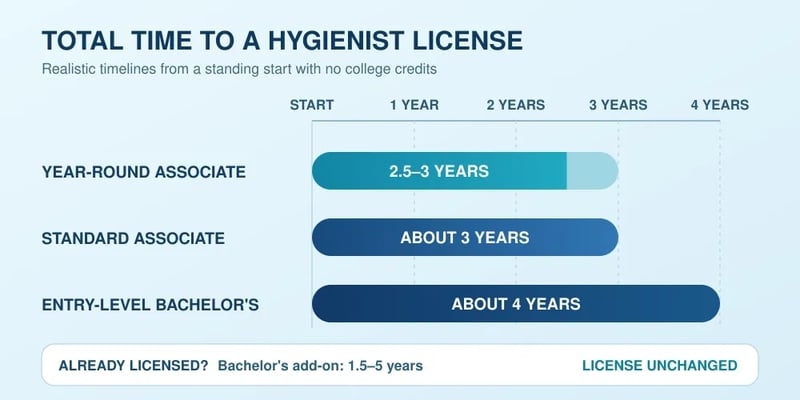
- Most people become a licensed dental hygienist about three years after starting prerequisites, with two of those years inside the accredited program.
- Every accredited hygiene program must include at least two academic years of full-time instruction, though year-round schedules can fit that into about 18 calendar months.
- A bachelor's degree in dental hygiene takes about four years, and licensed hygienists can add one later through online completion programs.
- Exams and the state license add a few weeks to a few months after graduation, and students can take the national board before they graduate.
- The hidden delay is the application calendar: many programs admit one class a year through a short window, and a missed cycle costs 12 months.

Step 1: Complete Prerequisite Coursework
Prerequisites take most applicants about a year, and sometimes two, before the hygiene program even starts. The American Dental Education Association counts up to 40 credit hours of prerequisite coursework in chemistry, English, speech, psychology, and sociology, and programs add their own science list on top. Diablo Valley College, for example, requires six science courses and five general education courses before you can apply.
Timing matters as much as the courses. A full-time student can clear the list in two or three semesters, while someone taking two classes a term will need closer to two years. At many programs, everything has to be finished by the application deadline rather than the program start date. The full dental hygienist prerequisites guide covers the course list, GPA minimums, entrance exams, and observation hours in full.
Step 2: Complete an Accredited Hygiene Program
The hygiene program takes two academic years for an associate degree and about four for a bachelor's, and it must be accredited by the Commission on Dental Accreditation (CODA) to count toward a license. CODA's accreditation standards require "at least two academic years of full-time instruction or its equivalent," which rules out a one-year hygiene degree at any accredited program. The American Dental Education Association puts the average associate program at two years and 84 credit hours, and the average bachelor's at four years and 120.
Two academic years is not the same as 24 calendar months, though. Lamar Institute of Technology in Texas tells applicants its associate degree "usually takes about 3 years including the prerequisites" and two years after acceptance, while year-round schedules compress the same curriculum. The routes break down like this:
- Associate degree, the most common entry-level route: two academic years and about 84 credit hours.
- Year-round associate: the same accredited curriculum on a continuous calendar, which Concorde, for example, advertises at as few as 18 months depending on campus.
- Entry-level bachelor's degree: about four years and 120 credit hours, with the prerequisites built into the degree.
- Degree completion for licensed hygienists: online RDH-to-BS programs such as Ohio State's run 1.5 to 5 years, and because they come after licensure, they never delay the license.
Getting in is often the slowest part of the whole timeline. Diablo Valley College accepts applications only from December 15 to February 15 each year, caps the class at 20 students, and selects by lottery followed by a points rubric that weights prerequisite coursework at 75 of 105 points. Sacramento City and Collin cap theirs at 24. An application submitted a week late waits a full year, which is why applying to more than one program in the same cycle is the practical hedge.
Step 3: Pass National and Regional/State Licensing Exams
Exams and the state license add roughly one to three months after graduation, longer in states whose boards take up to 90 days to process an application, and part of that work can happen before you finish school. The American Dental Hygienists' Association lists three requirements in every state: graduate from an accredited program, pass the written National Board Dental Hygiene Examination, and pass a regional or state clinical board examination.
- National Board Dental Hygiene Examination (NBDHE): the Joint Commission on National Dental Examinations' 2026 candidate guide lists a $600 fee, 350 multiple-choice questions (200 discipline-based and 150 case-based), and 7 hours 30 minutes of testing. Students become eligible once the program director certifies they are prepared, so most people test during the final semester. Results arrive within four weeks, usually three, and every U.S. licensing jurisdiction accepts the exam.
- Clinical exam: the most widely accepted option is the ADEX Dental Hygiene Examination, a manikin-based clinical exam plus a computer simulation, at $1,150 plus a facility fee, open to students and graduates of CODA-accredited programs. The ADEX acceptance map updated in March 2026 shows nearly every jurisdiction accepting it for initial licensure, with Delaware and Nebraska the named exceptions. The Joint Commission's DHLOSCE, launched in 2025, is a written station-based alternative that Arizona, Kentucky, and Oregon accept.
- State license: each board adds its own steps, often a jurisprudence exam on state dental law, current CPR certification, and a fingerprint background check. The Texas State Board of Dental Examiners accepts ADEX and CRDTS-SRTA clinical scores, requires its jurisprudence assessment within a year of applying, and asks applicants to allow four weeks before checking status. The Dental Hygiene Board of California has 90 days by law to process a complete application, after which you sit for the state's law and ethics exam.
Total Timeline From Start to Licensed Hygienist
From a standing start with no college credits, plan on about three years to a license through an associate program and about four through a bachelor's.
What adds time:
- Missing the application window, since the next class at a once-a-year program starts 12 months later.
- Taking prerequisites part time, which turns a one-year stage into two.
- A lottery or waitlist year at a program with 20 to 24 seats.
- An exam retake, which adds the scheduling wait plus three to four weeks for NBDHE results.
What saves time:
- Finishing every prerequisite before the application deadline, not the program start date.
- Taking the NBDHE in the final semester as soon as the program director signs off.
- Booking the clinical exam around graduation rather than months after it.
- Submitting the state application with fingerprints, CPR card, and jurisprudence exam already done.
If three years is longer than you want to spend before working chairside, dental assisting takes about a year through a certificate program, and Dreambound lists dental assistant programs you can compare by length and cost.
Frequently Asked Questions
What are the steps to become a dental hygienist?
- Finish high school or a GED and complete the college prerequisite courses, usually about a year.
- Complete a CODA-accredited dental hygiene program, two academic years for an associate degree or about four for a bachelor's.
- Pass the National Board Dental Hygiene Examination, which you can take in your final semester.
- Pass a clinical exam your state accepts, such as the ADEX Dental Hygiene Examination or the DHLOSCE.
- Apply for your state license, with any jurisprudence exam, CPR card, and background check.