Key Points
- A general dentist handles routine checkups, cleanings, fillings, and most everyday dental care.
- Specialists complete additional years of training beyond dental school in a specific area.
- Common specialties include orthodontics, periodontics, endodontics, prosthodontics, oral surgery, and pediatric dentistry.
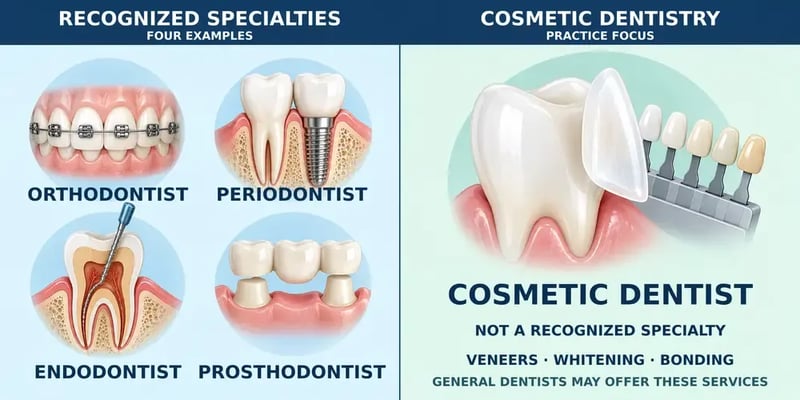
- "Cosmetic dentist" is a commonly used term but is not an officially recognized dental specialty in the same way the others are.
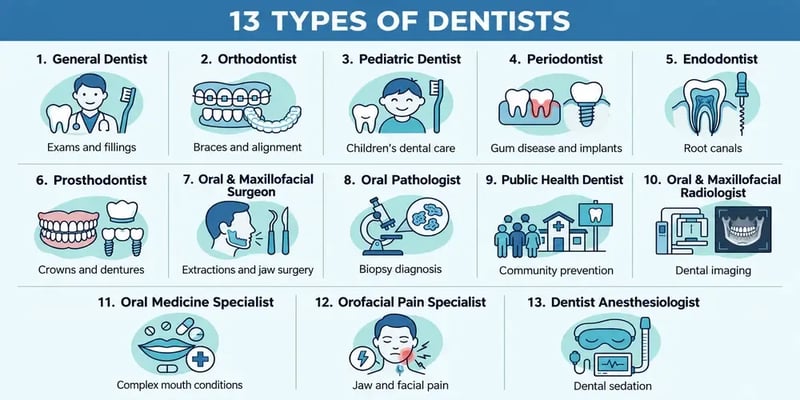
The table below lists general dentistry and all 12 specialties recognized by the National Commission on Recognition of Dental Specialties and Certifying Boards, the ADA-affiliated body that decides which fields count as specialties.
General Dentist
A general dentist is the dentist most people mean when they say "my dentist." The role covers exams, cleanings, x-rays, fillings, crowns, and preventive care, and many general dentists also place implants, offer whitening, or handle simple extractions. General dentists hold a DDS or a DMD, and the two degrees are the same credential with different names.
The general dentist is also the referral point for everything else on this page. According to the ADA Health Policy Institute, about 21% of active dentists are specialists and the rest are general practitioners, so the general dentist sees most problems first, treats what falls inside general practice, and refers the rest.
Orthodontist
An orthodontist corrects the position of the teeth and jaws. The American Association of Orthodontists describes the specialty as diagnosing and treating irregularities of the teeth and jaws, and its formal name, orthodontics and dentofacial orthopedics, covers both crooked teeth and the way the upper and lower jaws grow and meet. Braces, clear aligners, retainers, and growth appliances are the everyday tools.
Becoming one takes a two- to three-year orthodontic residency after dental school. You would see an orthodontist for crowding, gaps, an overbite or underbite, or a jaw that does not close evenly. The visit often starts with a general dentist who spots the problem at a checkup, though orthodontists also see patients directly. Orthodontic practices also rely on a separate support role, the orthodontic assistant, who handles wire changes and impressions chairside.
Pediatric Dentist
A pediatric dentist treats infants, children, and adolescents, including patients with special health care needs. The American Academy of Pediatric Dentistry calls pediatric dentists the pediatricians of dentistry, and the training reflects that: two to three years of specialty residency after dental school focused on child development, behavior management, and the growing mouth.
The practical difference from a family dentist is the setting and the approach. Pediatric offices are built for children, the team is trained to manage anxiety and behavior, and the dentist tracks how baby teeth, permanent teeth, and jaw growth are lining up. A child with a complex medical condition, severe anxiety, or early orthodontic concerns often goes straight to a pediatric dentist.
Periodontist
A periodontist treats the gums and the bone that holds the teeth in place. The American Academy of Periodontology (AAP) defines the specialty as the prevention, diagnosis, and treatment of periodontal disease and the placement of dental implants, and periodontists complete three additional years of training after dental school.
Most referrals start with gum disease that has moved past what a cleaning can fix: deep pockets, bone loss, or gums that bleed and recede. Periodontists perform deep cleanings called scaling and root planing, gum and bone grafts, and gum surgery, and the AAP calls them dentistry's experts in the surgical placement of dental implants.
Endodontist
An endodontist treats the inside of the tooth. The American Association of Endodontists (AAE) describes endodontists as specialists in diagnosing and treating tooth pain and performing root canal treatment, with at least two extra years of training beyond dental school.
The volume is the difference. The AAE notes that an endodontist performs an average of 25 root canal treatments a week, while a general dentist may do about two. General dentists do perform root canals, but a tooth with a complicated root structure, a failed earlier root canal, or damage from an injury is usually referred to an endodontist, and so is persistent tooth pain with no obvious cause.
Prosthodontist
A prosthodontist restores and replaces teeth. The American College of Prosthodontists describes three years of extended training after dental school in crowns, bridges, complete and partial dentures, implant restorations, and esthetic work. The specialty's formal definition covers the rehabilitation and maintenance of oral function, comfort, and appearance in patients with missing or deficient teeth.
A general dentist handles a single crown or a simple bridge. A prosthodontist takes the cases with many moving parts: several missing teeth, a full-mouth reconstruction, worn or damaged bites, and implant-supported dentures. A further year of fellowship training in maxillofacial prosthetics prepares some prosthodontists to rebuild facial structures after cancer surgery or trauma.
Oral and Maxillofacial Surgeon
An oral and maxillofacial surgeon, or OMS, is the surgical specialist of dentistry. The American Association of Oral and Maxillofacial Surgeons describes a hospital-based surgical residency of four to six years after dental school, with residents training alongside medical residents in internal medicine, general surgery, and anesthesiology. Six-year programs such as the University of Alabama at Birmingham's also award a medical degree.
The referrals are the ones that sound like surgery: impacted wisdom teeth, complex extractions, dental implants, corrective jaw surgery, facial trauma and fractures, oral cancer and other pathology, cleft lip and palate, and TMJ disorders. Oral surgeons also train in all aspects of anesthesia administration, so wisdom teeth are commonly removed under sedation in the surgeon's office, which is the only time many patients meet one.
Oral Pathologist
An oral and maxillofacial pathologist diagnoses the diseases that affect the mouth, jaws, and face. The specialty's definition covers the nature, identification, and management of diseases in the oral and maxillofacial region. Much of the work happens away from the chair, examining biopsy tissue under a microscope to confirm or rule out conditions such as oral cancer, salivary gland disease, and diseases of the jawbone.
Training runs three to four years after dental school at programs such as Harvard's oral and maxillofacial pathology residency. Patients rarely book an oral pathologist directly. A general dentist or oral surgeon takes the biopsy and sends it to the pathologist for the diagnosis that decides the treatment.
Public Health Dentist
A dental public health specialist works on oral health at the community level rather than one patient at a time. The specialty's definition centers on preventing and controlling dental diseases and promoting dental health through organized community efforts, which day to day means school sealant programs, community water fluoridation, oral health surveillance, and the policy work behind access to care.
Public health dentists complete a residency in dental public health after dental school and typically work for health departments, federal agencies such as the CDC, universities, and nonprofit clinics rather than in private practice. You are unlikely to be their patient, but their programs shape which services exist in your county.
Four Other ADA-Recognized Specialties
Four more specialties round out the list of 12, and most patients only meet them through a referral. An oral and maxillofacial radiologist specializes in producing and interpreting dental and facial imaging, from routine x-rays to cone-beam CT scans.
An oral medicine specialist works at the intersection of dentistry and medicine, managing mouth diseases in medically complex patients: oral mucosal conditions, salivary gland disorders and dry mouth, and the oral side effects of cancer treatment. An orofacial pain specialist treats pain disorders of the jaw, mouth, face, head, and neck, including TMJ disorders. Both specialties were recognized in 2020 and are the newest on the list.
A dentist anesthesiologist provides sedation and general anesthesia for dental and oral surgery, often for young children, patients with special needs, and severe dental anxiety. The specialty was recognized in 2019, and the American Dental Education Association lists its residency programs at 36 months.
Is "Cosmetic Dentist" a Real Specialty?
No. Cosmetic dentistry is not one of the 12 recognized specialties, and no Commission-recognized board certifies dentists in it the way the American Board of Orthodontics certifies orthodontists. Any licensed general dentist can offer veneers, whitening, bonding, and smile makeovers, so "cosmetic dentist" describes what a practice chooses to focus on rather than a credential earned through extra training.
The ADA's Principles of Ethics and Code of Professional Conduct draws the line clearly. A dentist may announce as a specialist only in a specialty the National Commission recognizes, or one a state has formally recognized. General dentists who advertise cosmetic work must avoid any communication that implies specialization and must state that the services are provided by general dentists. A dentist who advertises a credential in a non-specialty area must also state that the area is not recognized as a specialty by the National Commission.
That does not make cosmetic work lesser. It means the credential to look for is the dentist's training and case results, and for complex esthetic reconstruction the recognized specialist is the prosthodontist.