Key Points
- Certificate and diploma programs are generally the lower cost, faster option.
- Associate degree programs cost more but include general education credits and can lead to further career mobility.
- Tuition is rarely the only cost, since supplies, a uniform, background checks, and certification exam fees typically add to the total.
- Community colleges are generally more affordable than private vocational schools for equivalent training.
Average Cost of a Dental Assistant Program
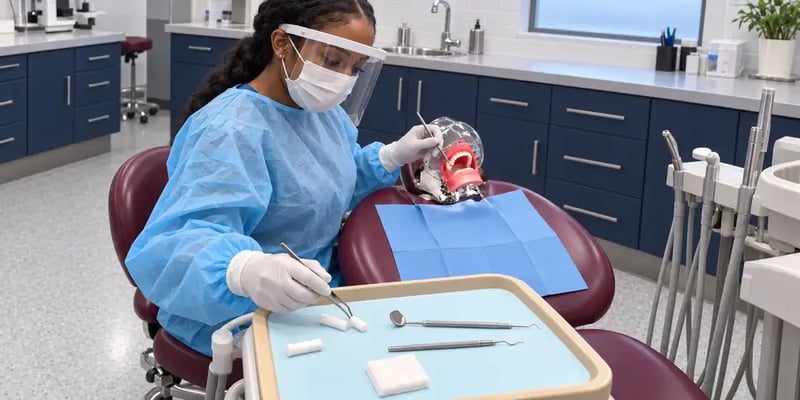
Prices published as of 2026 fall into three tiers. Accelerated hybrid certificates run $2,950 to $3,650 for 12 weeks. Community college certificates in California, where the per-unit fee is $46, total about $3,000 to $3,700 for a one-year program once uniforms and supplies are counted, and more in states with higher public tuition. Private career colleges charge far more for a similar certificate, with Carrington College's 36-week program in Phoenix listed at $21,293 on Arizona's state training provider list.
Associate degrees add general education on top of the same clinical coursework, which means about $8,300 in tuition and fees over two years at an average public college, or about $33,700 for ECPI University's 15-month associate.
Certificate and Diploma Program Costs
Community colleges are the most affordable route to the same entry-level qualification, and the Bureau of Labor Statistics notes that most dental assisting programs are offered there and take about a year. Pasadena City College, a CODA-accredited program approved by the Dental Board of California, puts its total at $3,054, of which only $1,679 is tuition for 36.5 units. Santa Rosa Junior College's cost sheet lands at $3,660, and eligible first-time California students can have the tuition portion waived for two years.
Dedicated vocational and trade schools sit at the other end. Carrington College's Phoenix campus runs a 36-week hybrid dental assisting certificate that Arizona's Eligible Training Provider listing prices at $21,293 including fees, and its Tucson campus is listed at $22,367.
Accelerated hybrid programs are the fastest and often the cheapest option. The Dental Assistant School campuses that partner with Dreambound charge $2,950 for 12 weeks at locations like Dallas Dental Assistant School in Plano and $3,650 at San Antonio Dental Assistant School Northwest, with $450 due to start. Dreambound's roundup of the cheapest and fastest dental assistant programs compares more of them side by side.
Associate Degree Program Costs
A dental assistant degree, meaning the two-year associate, costs more because it adds a year or so of general education to the clinical coursework. At the College Board's 2025-26 average of $4,150 a year for public two-year colleges, that is about $8,300 in tuition and fees, plus the same kit, uniform, and exam costs a certificate student pays.
Private colleges charge several times that. ECPI University's dental assisting associate in Manassas, Virginia, is a 63-credit, 15-month hybrid program taken over a minimum of four semesters, and ECPI's published tuition is $7,848 a semester plus a $570 technology fee, or about $33,700 for the degree.
Students choose the associate anyway for reasons that have little to do with entry-level pay. It is a broader credential, and the general education credits can transfer toward a bachelor's degree later without starting over.
What's Actually Included in Program Cost?
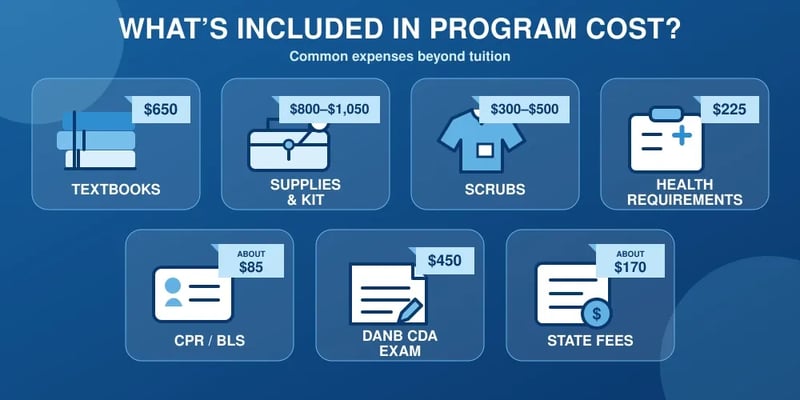
Tuition is the headline number, but the cost sheets colleges publish show how much sits underneath it. Santa Rosa Junior College's 2024 sheet and Pasadena City College's estimate line up on the same items:
- Textbooks: $650 at Santa Rosa.
- Clinic supplies and an equipment kit: $1,050 at Santa Rosa and about $800 at Pasadena.
- Scrubs, shoes, masks, and gloves: $300 at Santa Rosa, while Pasadena budgets about $500 for uniforms.
- Health requirements such as immunizations and a TB test: $225 at Santa Rosa.
- Background check, drug screen, and compliance tracking: required before clinical work at most programs, with Santa Rosa's tracking subscription at $50. Some programs bill student liability insurance as well.
- Student association membership: $75 at Pasadena.
- CPR or BLS card: about $85.
Certification is usually a separate line. The DANB Certified Dental Assistant exam costs $450 for all three components in 2026, including a nonrefundable $75 application fee, or $270 for a single component, and the entry-level NELDA exam is $400. State fees are smaller, since California's registered dental assistant application is $120 and its written exam is $46.59.
Some schools bundle part of this, so ask: San Antonio Dental Assistant School covers its students' radiology exam, while the California colleges above leave state exam fees out of their totals.
What Affects Dental Assistant Program Cost?
Five things move the price, and one of them matters far more than the rest.
- Public versus private ownership: Pasadena's CODA-accredited certificate totals $3,054 while Carrington's Phoenix certificate is listed at $21,293, and both lead to the same entry-level job.
- Program length: every extra week of instruction is a week you pay for, from a 12-week course to a 36-week certificate to a 15-month associate degree.
- Format: Carrington's certificate and the Dental Assistant School course are both hybrid, and one costs about six times the other, so delivery moves the price less than ownership does.
- Location: geography shows up mostly through public tuition, which varies widely by state, with California's $46-per-unit fee at the low end.
- Accreditation: a CODA-accredited program is the direct route to the DANB CDA exam, since graduates qualify without logging 3,500 hours of work experience first, and accreditation is a condition for federal financial aid.
Accredited programs sometimes cost more, but the recurring regret in a long-running r/DentalAssistant thread on program prices came from people who paid $3,000 to $15,000 for unaccredited quick courses and then had to certify on their own.
How to Pay for a Dental Assistant Program
The funding routes below can be combined, and which ones apply depends mostly on whether the school participates in federal aid.
- Federal aid through the FAFSA: the maximum Pell Grant is $7,395 for the 2026-27 award year, enough to cover a community college certificate outright, but only at participating schools. The Federal Student Aid Handbook requires those schools to be accredited by a recognized agency and, in most cases, to run programs of at least 600 clock hours over 15 weeks. That leaves many 12-week programs outside federal aid.
- Workforce grants: the Workforce Innovation and Opportunity Act funds training through about 2,300 American Job Centers, and each state keeps an eligible training provider list like the Arizona one cited above.
- Employer-sponsored training: HealthLinc, an Indiana community health center, pays the $7,350 tuition for its four-month program in exchange for a two-year employment agreement. CHAS Health in Spokane and the Eastman Institute for Oral Health in Rochester run paid training programs that start at $18 to $21 an hour.
- Payment plans: the 12-week programs above take $450 to start, and schools outside federal aid commonly offer in-house plans for the balance.
- Scholarships: DANB lists several, including the ADAA/DANB and Liz Koch Memorial scholarships, that award $250 to $1,000 toward tuition or exam fees.
Is a Dental Assistant Program Worth the Cost?
Measured against pay, the math is favorable. Dental assistants earned a median of $48,070 a year, or $23.11 an hour, in May 2025, and even the 10th percentile, a fair proxy for entry-level pay, was $37,130. A $3,650 program is about five weeks of pay at that starting level, and a $21,293 private certificate is still under half a year of median pay. BLS projects 7% growth from 2025 to 2035 with about 53,000 openings a year.
The timeline is the other half of the value, since twelve weeks to a year is short next to most allied health paths. Certification pays too. DANB's 2024 survey found certified dental assistants earning a median of $26 an hour against $22.50 for non-certified ones, a gap of roughly $7,000 a year at full-time hours that alone repays a community college program in the first year.
The Reddit thread is a useful reality check: reactions to $2,500 to $3,000 short courses were split, the sharpest regrets came from unaccredited programs and from $15,000 to $25,000 private ones, and several commenters trained on the job and paid only for exams. If you finish a general program and want a specialty later, the orthodontic assistant path adds a DANB credential rather than another degree.
Frequently Asked Questions